When a PLC, HMI, industrial PC, or variable frequency drive (VFD) suddenly reboots during normal operation, troubleshooting can be quite challenging. By the time a technician arrives to take measurements, the power supply may have returned to normal, causing a multimeter to display a perfectly standard voltage level.
This is why on-site inspections are sometimes insufficient to explain the issue; the critical period is the moment immediately preceding the device's reset. A momentary voltage dip, an overvoltage spike, or a power fluctuation occurring at that exact instant may well have vanished before the technician could measure it.
Does a device resetting itself necessarily mean the device itself is faulty?
Not necessarily. The power supply to the equipment must also be examined before concluding that the fault lies with the PLC, HMI, variable frequency drive (VFD), or power supply unit.
Electronic devices and industrial controllers vary in their sensitivity to voltage fluctuations. A voltage dip can cause a controller to lose power or reboot, while other devices on the same circuit continue to operate. Fluke has also noted that short-term voltage dips and surges can cause electronic equipment to malfunction or trigger relays unintentionally.
Therefore, the question to address is not simply "which device is faulty?" but rather "what happened to the power supply at the moment the fault occurred?"
Even a very brief voltage drop can cause the machine to stop
A voltage sag is a phenomenon where the RMS voltage drops below normal levels for a specific duration. IEEE 1159 defines a voltage sag as a decrease in RMS voltage to between 0.1 and 0.9 per-unit (pu), lasting from 0.5 cycles to one minute.
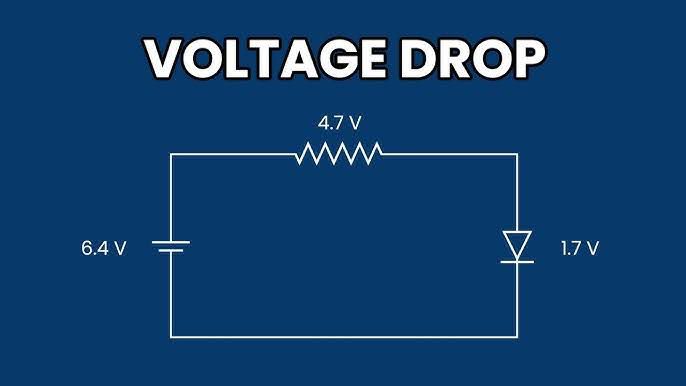
In automated production lines, even a brief sag can cause significant issues. Common triggers include the high inrush current from starting a large motor, a short circuit on another branch, or the switching of heavy loads. If the voltage drop exceeds the tolerance limits of power supplies or control circuits, devices such as PLCs or variable frequency drives (VFDs) may trigger protective mechanisms and halt operations.
When the voltage subsequently recovers and the equipment automatically restarts, everything appears normal; this scenario makes the fault particularly difficult to diagnose.
Why does measuring voltage with a standard meter sometimes fail to detect a fault?
Suppose a device resets itself at 10:35:27 and a technician checks it at 10:40; the measured voltage might appear normal because the disturbance ended several seconds or cycles earlier.
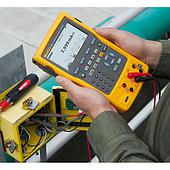
A handheld meter indicates the electrical status only at the moment of measurement, whereas a power quality analyzer can record power supply behavior over an extended period and log anomalies for later review. This is a crucial distinction when troubleshooting intermittent or irregular faults.
How does a power quality analyzer identify the cause of a problem?
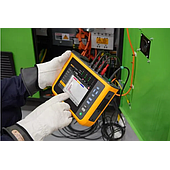
The approach is quite straightforward: connect voltage probes and current clamps at the power distribution panel supplying the device that frequently resets, then let the data logger run long enough to capture the issue when it recurs.
With Fluke power quality analyzers, users can configure trigger conditions to capture events such as voltage dips, swells, outages, current fluctuations, and voltage transients. The device also captures pre- and post-event waveforms, allowing for the analysis of conditions surrounding the anomaly. Consequently, rather than relying on vague descriptions such as the machine shutting down for a few seconds before restarting engineers can correlate the reset times with the corresponding electrical data.
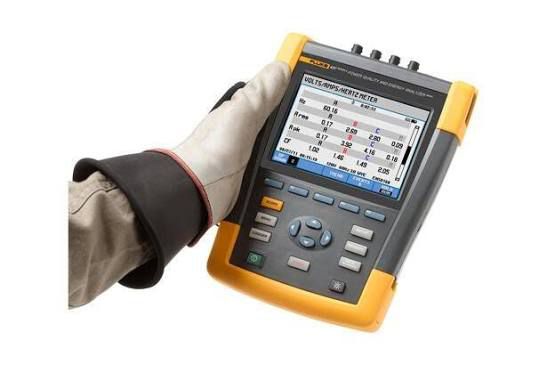
How do you interpret the data to determine if the fault originates from the power supply?
Certain types of data can help quickly narrow down the cause; for instance, a simultaneous, sharp drop in voltage across all phases followed by recovery may indicate a voltage sag or power interruption. If this timing coincides with the restarting of a PLC, HMI, or industrial computer, the power supply becomes a key area for investigation.
A sharp spike in current immediately preceding the voltage drop suggests a different scenario. The startup of a large load, a fault on a power branch, or a short circuit can trigger current fluctuations that result in a voltage sag. This type of data is particularly useful in facilities where multiple high-power motors operate simultaneously.
Brief voltage transients also warrant consideration. These transients which can stem from load switching or lightning strikes have the potential to cause electronic equipment to shut down, even if standard meters fail to capture the event.
Harmonics must not be ignored when the device repeatedly resets
Voltage sags are not the only factor to consider. Facilities utilizing numerous variable frequency drives (VFDs), electronic power supplies, industrial computers, or non-linear loads may experience waveform distortion and harmonics.
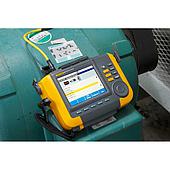
Power quality analyzers enable the monitoring of parameters such as voltage, current, power, harmonics, and unbalance. When issues recur at specific times, correlating this data can help identify a link between active loads and equipment resets—highlighting why a single on-site measurement is often insufficient for diagnosing intermittent faults.
See also:
Theo Dõi Điện Năng Tiêu Thụ 3 Pha Liên Tục Để Biết Nhà Máy Đang Dùng Điện Ra Sao
Identifying the causes of short-term power outages using a power analyzer
Where should the measuring device be placed to detect faults faster?
The measurement location significantly influences the ability to identify the root cause; placing the device at the main electrical panel allows engineers to determine whether fluctuations are present in the facility's common power supply. Moving the measurement point to a distribution panel that directly feeds the production line or the faulty equipment helps narrow the scope of the investigation.
For complex issues, measurements can be taken at two locations to compare the timing of events. If a fluctuation originates at the upstream source before propagating to the load, the investigative approach differs from a scenario where the anomaly is confined to a specific branch supplying a particular machine. This setup is particularly useful when multiple devices experience resets, but the cause whether it stems from the common power supply or an individual load branch remains unclear.
How often should data be recorded?
There is no fixed timeframe applicable to every plant. If a fault occurs several times per shift, the recording period can be relatively short. However, for issues that arise only every few days or weeks, monitoring must continue for a longer duration to capture the specific moment the anomaly occurs.

More importantly, the recording period must be long enough to cover operational states capable of triggering faults, such as large motor startups, capacitor bank switching, power source transfers, or load changes.
A device that spontaneously restarts should not immediately be assumed to have a hardware fault. If the issue occurs sporadically, checking the power supply can help rule out or confirm a critical potential cause before proceeding with component replacement.
The process can begin by precisely identifying the malfunctioning device, the time of occurrence, and the frequency of the issue. A power quality analyzer is then installed at the power supply point to record data continuously. When the device resets again, engineers correlate the time of the event with occurrences such as voltage sags, power outages, transients, current fluctuations, or harmonics.
This approach transforms an intermittent "spontaneous reset" issue into a problem with analyzable data, enabling the maintenance team to decide whether to monitor the power source, inspect load branches, review control equipment, or investigate the utility grid as the potential cause.
EMIN offers power quality analyzers designed for measuring and recording 3-phase electrical data, making them ideal for troubleshooting intermittent electrical faults in factories, production facilities, and automation systems.
In summary: When equipment spontaneously restarts for an unknown reason, recording power quality at the exact moment of the incident is a valuable method for determining whether voltage sags, momentary outages, transients, or current fluctuations are contributing to the fault.