Yes. By simply knowing the drum's rotational speed (RPM) and its diameter, you can calculate the conveyor belt speed in meters per minute. This is a common calculation method used when inspecting, calibrating, or evaluating the performance of industrial conveyor systems.
Why can't you determine the conveyor belt speed simply by looking at the RPM?
RPM (Revolutions Per Minute) indicates the number of rotations per minute, whereas a conveyor belt moves based on distance.
Reference: What is RPM and why is this parameter found everywhere?
A single rotation of the drive drum advances the conveyor belt by a distance equal to the drum's circumference. Therefore, to convert RPM to meters per minute (m/min), the drum's dimensions must be known.
For example:
+ A large drum moves the belt a greater distance with each rotation.
+ A small drum rotating at the same RPM results in slower belt movement.
+ This explains why two conveyor belts operating at the same 100 RPM can still have completely different actual speeds.
Formula for calculating conveyor belt speed from RPM
The calculation can be performed using the following steps:
Step 1: Measure the rotational speed of the drum
Use a tachometer to determine the revolutions per minute (RPM).
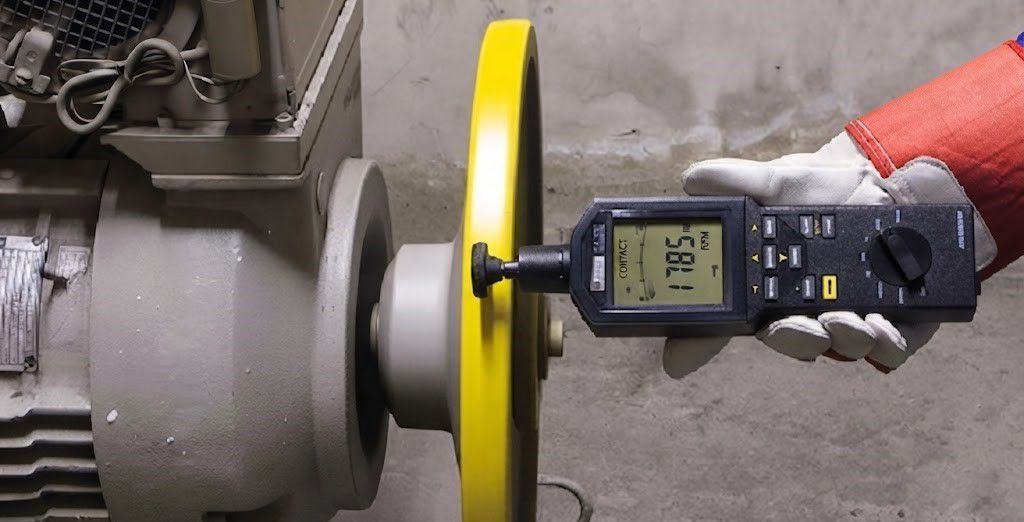
Reference model: VICTOR 6234P digital tachometer (2.5 – 99,999 RPM)
Step 2: Measure the drum diameter
Measure the diameter of the drive drum (the drum that drives the conveyor belt); the unit of measurement is meters (m).
Step 3: Calculate the drum circumference
Where:
C: Drum circumference (m)
D: Drum diameter (m)
Step 4: Calculate the conveyor belt speed
Where:
V: Conveyor belt speed (m/min)
RPM: Drum rotation speed
Practical calculation example
A drum has:
- Diameter: 250 mm (0.25 m)
- Rotation speed: 120 RPM
- Drum circumference:
3.1416 × 0.25 = 0.785 m
- Conveyor belt speed:
120 × 0.785 = 94.2 m/min
This means the conveyor belt moves approximately 94 meters in one minute.
Is it necessary to measure the engine's RPM?
That is not always feasible.
If the motor drives the system through a gearbox, the motor's RPM will be significantly higher than the drum's RPM.
For example:
- Motor: 1450 RPM
- Gearbox ratio: 20:1
The drum's RPM would be only:
1450 ÷ 20 = 72.5 RPM
If you use the motor's RPM directly to calculate the conveyor speed, the result will be significantly inaccurate.
Therefore, you should:
+ Measure directly at the drive drum.
+ Or know the exact gearbox ratio before performing the conversion.
+ Is measuring RPM with a laser more accurate?
For many conveyor systems, laser tachometers are a popular choice because:
+ They do not require contact with the rotating shaft.
+ Measurements can be taken while the drum is in operation.
+ They are safer for high-speed conveyors.
+ They are suitable for hard-to-reach locations.
You simply need to attach a reflective strip to the drum; the device will record the rotations and display the result almost instantly.
Besides RPM, what else should be checked?
If the conveyor belt speed does not match the design specifications, the cause is not necessarily the motor.
You should also check the following:
+ Whether the drum diameter is worn.
+ The gear reducer ratio.
+ Belt slippage on the drive drum.
+ Belt tension.
+ The VFD frequency (if applicable).
+ Considering these parameters together will help pinpoint the exact cause, rather than relying solely on RPM.
When should conveyor belt speed be measured?
Measuring RPM and converting it to m/min is typically performed when:
+ Calibrating a new production line.
+ Checking speed after replacing a motor or gearbox.
+ Assessing actual productivity.
+ Investigating abnormally slow or fast conveyor belt speeds.
+ Conducting routine maintenance to detect deviations before they impact output.