With different material samples, temperature can be monitored using a contact thermometer or an infrared thermometer when a quick surface check is needed.
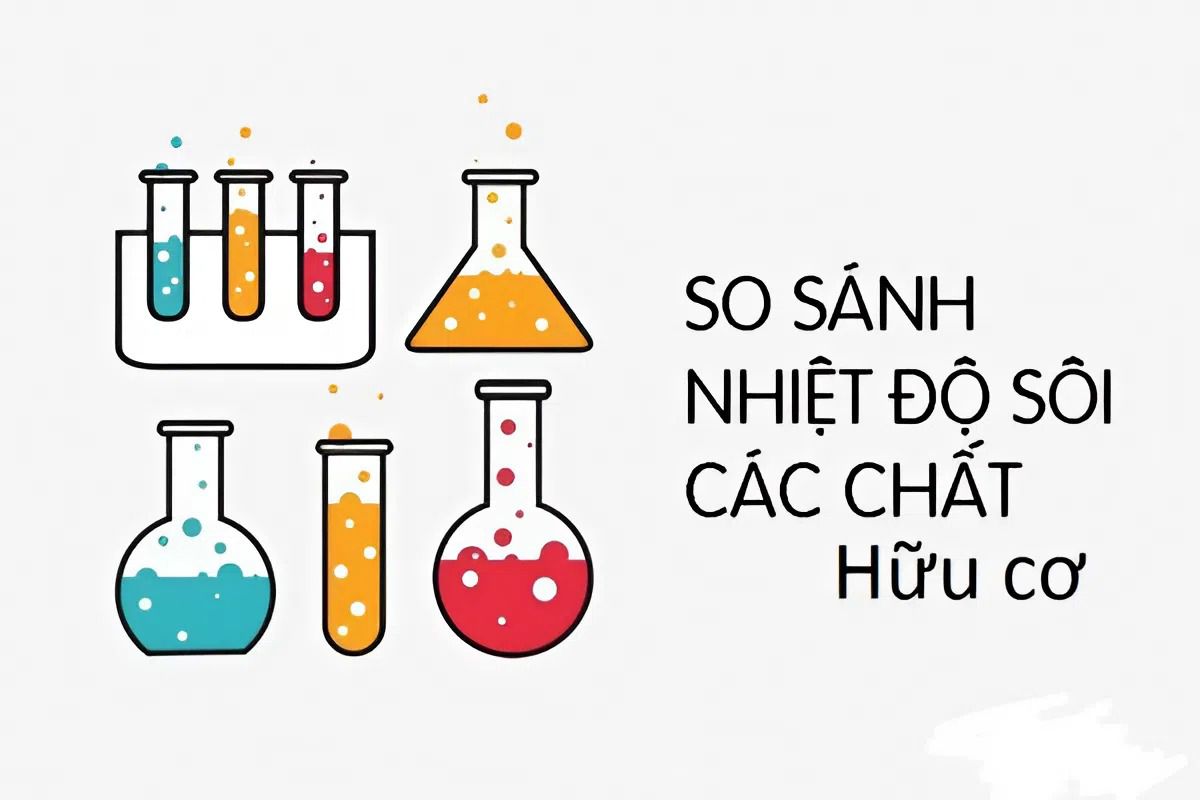
Boiling point of organic substances
Organic substances are usually of natural or synthetic origin, containing carbon-hydrogen bonds in their composition. This group is very common in everyday life, such as alcohols, sugars, and biological compounds.
In terms of boiling point, most organic substances do not have very high boiling points. However, each type still has its own threshold, depending on its molecular structure.
If we compare them by functional group, we can see the following trend:
COOH (acid) > OH (alcohol, phenol) > COO (ester) > CHO (aldehyde) > O (ether)
This difference stems from the ability to form hydrogen bonds and the polarity of each group.
In addition, the boiling point of organic compounds is also affected by several factors:
- The stronger the hydrogen bonds in a compound, the higher its boiling point.
- Intermolecular hydrogen bonds generally result in higher boiling points than intramolecular bonds.
- The larger the molecular mass, the higher the boiling point.
- More branched chains will have lower boiling points than straight chains.
For example, CH3COOH has a higher boiling point than HCOOH due to its larger molecular weight.
Boiling point of fats
Fats are also a type of organic compound, but they have a longer and more complex molecular structure, so their boiling points are usually higher.
The boiling point varies depending on the type of fat:
- Monounsaturated fats like olive oil and peanut oil usually boil above 100°C, and can reach around 240°C.
- Polyunsaturated fats like omega-3 and omega-6 usually boil above 120°C.
- Saturated fats, such as animal fat, typically boil above 130°C.
- Trans fats, such as margarine, can boil at around 150°C.
In general, fats have higher boiling points than water and much higher than many simple organic compounds. This is directly related to molecular size and the ability of molecules to bond together.
Boiling point of inorganic substances
Inorganic substances are compounds that do not contain carbon in their structure, except for some special cases such as CO, CO₂, or carbonate salts.
Compared to organic substances, inorganic substances generally have much higher boiling points. This is due to the strong ionic or covalent bonds, which require a large amount of energy to break.
The difference is clearly illustrated by a familiar example. Ethanol (C₂H₅OH) only boils at around 78.3°C, while an inorganic compound like CaCl₂ can reach thousands of degrees Celsius before turning into vapor.
The boiling points of organic substances, fats, and inorganic substances differ significantly, mainly due to their molecular structure and type of bonding. Organic substances generally have lower boiling points, fats have higher boiling points due to their larger molecules, while inorganic substances usually have very high boiling points.