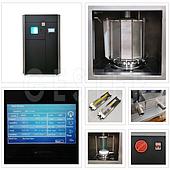
In addition, the machine also tests sensitivity, angle, fiber diameter, scattering, fiber recognition and continuity measurement. Using a fiber optic cable tester helps ensure optical transmission quality, helping to detect and fix problems quickly and effectively.
OTDR fiber optic cable meter?
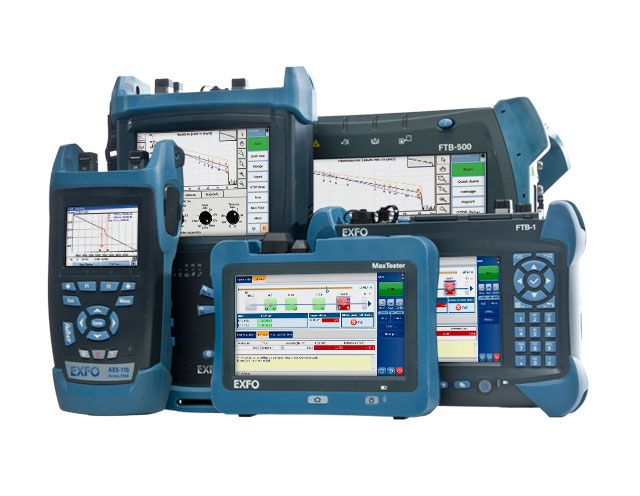
Optical Time-Domain Reflectometer (OTDR) fiber optic tester has the ability to test and determine the characteristics of fiber optic cables. When operating, the OTDR fiber optic cable tester will inject a stream of light pulses into the fiber optic cable to be tested. This light pulse travels along the fiber and when it encounters an error point, it is reflected back. At the end of the fiber, some of the signal is reflected back and some is ejected out of the fiber.
Based on the change in the amount of reflected pulses, combined with the emitted light length and pulse emitting time, the OTDR fiber optic meter determines the loss parameters and fiber length. This method is similar to the TDR (Time-Domain Reflectometer) meter used for copper cables, but instead of changes in impedance, the OTDR meter focuses on changes in the amount of reflected light pulses.
What purpose is an OTDR fiber optic cable tester used for?
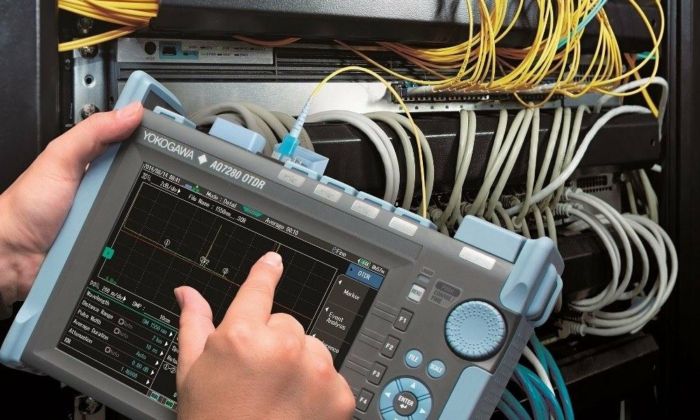
The OTDR fiber optic cable meter is used to determine the length and loss across the entire fiber optic cable, including overall loss, loss at splice points, connectors, and optical adapters. This device also helps detect fiber optic breaks on the inspection line.
To meet optical and electronic requirements as well as high professional requirements, OTDR fiber optic testers need to be able to display measurement results in graphic form, calculate and process optical results automatically and Exactly. For this reason, OTDR machines are integrated with many measurement and data processing modules. Therefore, OTDR operators must receive extensive training and education to use the equipment effectively and accurately.
OTDR fiber optic cable testers are often used to characterize the loss and length of newly shipped fiber optic cables, check cable braiding, transport to warehouse when cutting, and install after welding. Installation inspection can be more difficult due to long distances, multiple solder joints placed at short distances, or fibers with different optical properties being connected together. OTDR measurement results are often carefully stored in response to failures or warranty claims, to avoid serious damage due to loss of service.
OTDR fiber optic testers can measure at many different wavelengths and fiber types, usually common wavelengths such as 850nm, 1310nm, and 1550nm, to determine loss caused by connectors or solder joints. The optical dynamic range of an OTDR is limited by a mix of factors such as pulse width, input sensitivity, output power, and signal analysis time. The higher the optical pulse output power and the better the input sensitivity, the greater the measuring range, and these factors are often permanently integrated into each device..
A few notes when using fiber optic cable testers
Safety for the user:
OTDR measuring equipment works by using a laser light source emitted into the fiber to find errors in the cable. Laser light travels along the fiber, and when it encounters error points, it reflects or scatters back.
By measuring backscattered light beams due to Rayleigh scattering and reflected light beams due to connectors, solder joints and fault locations, the device can calculate path loss.
However, laser light is invisible to the naked eye, but if looked directly into the eye, it can cause vision loss or even eye damage. Therefore, when not connecting the connector to the OTDR measuring device, users should close the cover of the optical adapter to ensure eye safety.
Device safety:
When connecting the optical connector (jumper) to the machine, the user must insert it vertically and do so skillfully to avoid scratching or breaking the optical adapter.
Color liquid crystal touch screens (LCDs), similar to those on iPhones, can be damaged if subjected to strong impacts.
On the outside of the screen there is a thin layer of membrane used to filter and shield, and if strong force is applied to this barrier, the LCD touch screen may be damaged. Therefore, users need to be gentle when using and avoid strong impact on the touch screen.
When carrying the device, do not hold the device's stand to avoid damaging the device. The use of devices such as mobile phones, which can emit strong magnetic fields near the OTDR measuring device, can also affect the measurement results. Therefore, during the measurement process, devices that emit strong magnetic fields should not be placed near the OTDR fiber optic meter to ensure the machine operates smoothly and gives accurate results.
When carrying the device, do not hold it by the stand to avoid damaging the device. In addition, using devices that emit strong magnetic fields such as mobile phones near the measuring device may affect the measurement results. Therefore, these devices should not be placed near the OTDR fiber optic tester during the measurement process.
Conclude:
Above are my shares about OTDR fiber optic cable testers. If you need advice or a quote on any type of machine, you can contact us for the best support.