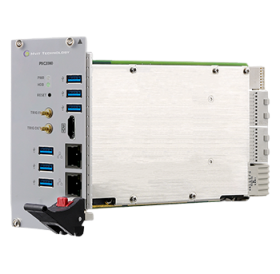
Processor: Intel® Core™ i7-6820EQ, 4 cores, 8 threads
Bus Specifications:
3U PXI Express
4-link architecture
PCIe ×4, Gen2
Storage: SATA 3.0, 500GB SSD
Front Panel Interfaces:
1 × HDMI display interface
6 × USB 2.0 Type-A ports
2 × Ethernet ports (10/100/1000 Mbps)
TRIG-IN: PXI trigger input
TRIG-OUT: PXI trigger output
Mechanical Characteristics:
Compliant with PXI Express Hardware Specification Rev. 1.0
Form factor: 3U, 3-slot width
Operating System: Windows 7 / Windows 10
Environmental:
Operating temperature: -20°C to +50°C
Storage temperature: -40°C to +70°C
Humidity: 5% to 95% (non-condensing)
The PXC2190 PXI Express Embedded Controller is based on the 7th generation Intel® Core™ i7 processor, specifically designed for hybrid PXI Express-based test systems, providing maximum computational power for various test and measurement applications. The PXC2190 combines the 7th generation Intel® Core™ i7 processor with up to 32 GB of 2400 MHz DDR4 memory. It uses a dedicated computing engine on a single processor, allowing for the simultaneous execution of multiple independent tasks in a multitasking environment. The PXC2190 supports four-link x4 or dual-link x8 PXI Express link functionality, with a maximum system throughput of 16 GB/s over the PCI Express 3.0 bus.
The PXC2190 offers ample interface flexibility, including two DisplayPort connectors for connecting to two monitors, dual USB 3.0 connections for high-speed peripherals, dual Gigabit Ethernet ports (one for LAN connection and the other for controlling LXI instruments), four USB 2.0 ports for peripheral devices and USB instrument control, and a Micro-D GPIB connector for GPIB instrument connection, making it suitable for controlling hybrid PXI-based test systems.