Why EMC Can't Stop at Books
Many students majoring in Electrical and Electronics and Telecommunications can write Maxwell’s equations fluently but have difficulty relating theory to real devices. Learning only through lectures makes knowledge abstract, making it difficult to visualize the impact of electromagnetic interference on real products.
When a school has the conditions to invest in a standard EMC testing system, students no longer learn theory alone but can observe, measure and handle problems directly on the device. This practical experience shortens the time for students to achieve the practical skills necessary for future work.
What is needed for an EMC testing system in the field to be usable?
Basic measuring devices such as Rohde & Schwarz spectrum analyzers, Rohde & Schwarz signal generators, in which the EMC testing equipment lines distributed by EMIN are popular in many laboratories, suitable for both training and research.
In a learning environment with an EMC testing system for teaching, there should be a radio anechoic chamber, a shielded room for signal measurements, and basic measurement equipment such as spectrum transceivers, signal sources, and shielded probes for students to practice with. Simulation software such as HFSS, CST, or ADS should be integrated into the curriculum for students to simulate before actual measurements.
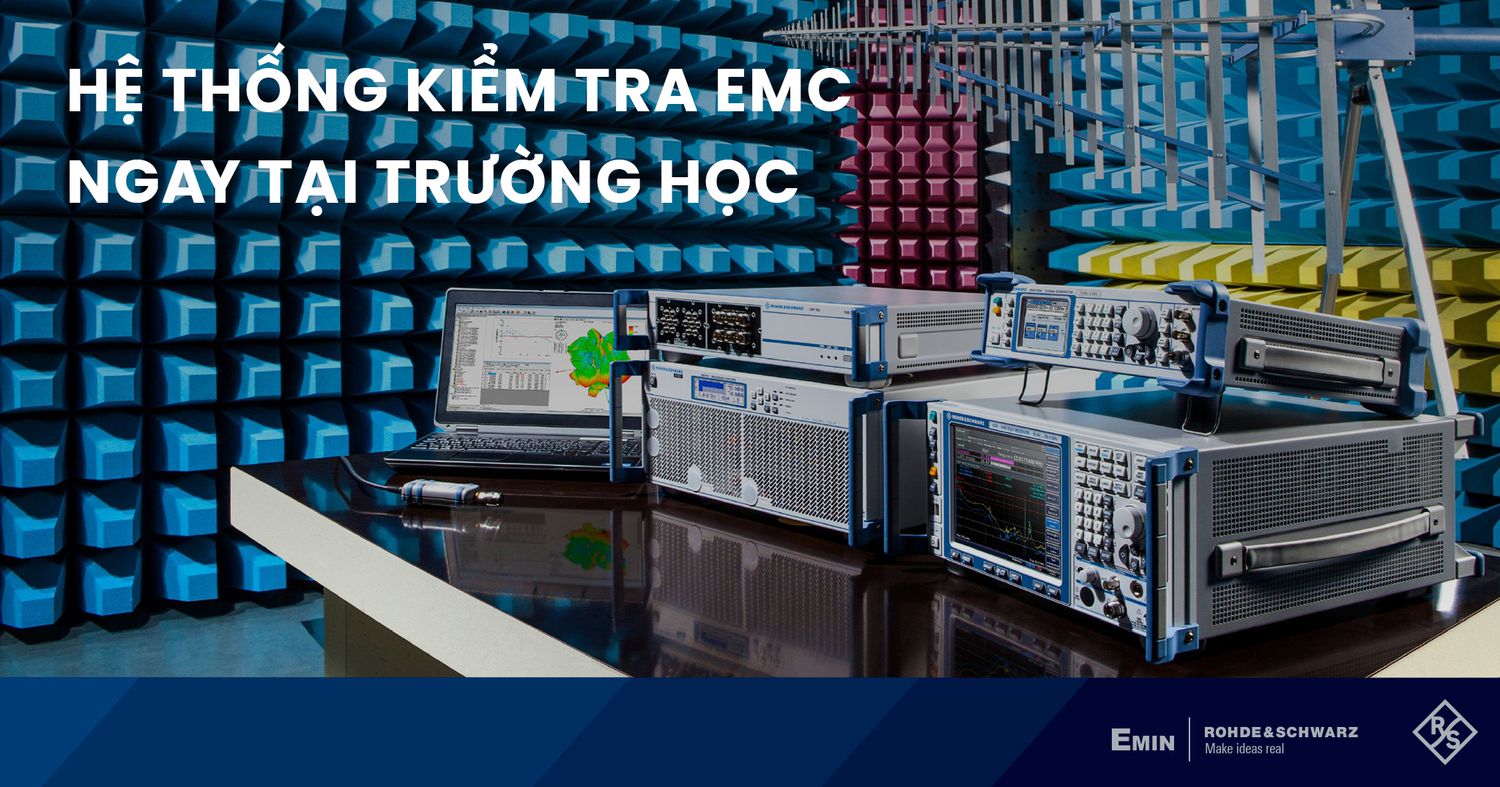
In addition to the equipment and software, there should be a set of practice exercises with increasing challenge: from simple measurements on the circuit board, to transmission line analysis, to EMI measurement and troubleshooting for a complete system. The combination of simulation and actual measurements helps students understand why a design works well in simulation but has problems in the test room.
How to make the curriculum closely follow business needs
Schools should collaborate with internationally accredited testing laboratories to develop practical exercises that are close to the certification standards. This helps students grasp international standards and understand the steps required to properly bring products to market. An ISO IEC 17025 accredited laboratory is an important reference for designing exercises and grading criteria for practical exercises.
On the other hand, schools can invite experts from testing laboratories such as TÜV Rheinland or EMC service companies to train lecturers and students. This cooperation helps to update the latest standards and create conditions for students to practice in the testing laboratories themselves.
Equipment and skills students need to master
Students should approach two sets of skills in parallel. The first set is basic instrumentation testing skills such as spectrum, emission and sensitivity measurements. The second set is simulation and EMI avoidance design skills for PCBs and systems, using HFSS or CST to predict propagation paths and couplings.
Soft skills are equally important. Being able to read standards, write clear test reports and coordinate with the design team to modify circuits will be a big plus when you apply for a job in the R&D or testing department of a company. Good schools teach these skills as well.
Human resource needs and career opportunities in Vietnam
The electronics market in Vietnam is growing rapidly, from consumer devices to semiconductors and electric cars. Therefore, the demand for engineers with practical EMC skills is very high. Many domestic enterprises now send their products to domestic standard testing laboratories to save time and costs.
Just having practical experience in an EMC laboratory is a big advantage for graduates when applying for positions at inspection companies, quality assurance departments of large corporations or research departments of electronic equipment manufacturers. This is a practical career path and is being sought after by the market.
Where to start to build an affordable EMC testing system for school
Not every school needs a 10-meter anaesthesia chamber right from the start. A viable route is to start with a small shielding room, a basic set of instruments, and a simulation software package for a lab. Once it’s implemented in teaching and has results with students, the school can fundraise or partner with businesses to upgrade to a larger chamber.
Schools should also seek out partnerships with educational equipment vendors. Some companies offer educational support programs that provide discounted educational equipment packages and course materials to shorten the time to implementation. A rolling start reduces the financial burden and creates a multiplier effect as more students support local businesses through hands-on learning.
Conclusion and specific actions
Putting EMC testing systems into practice is not a trendy trend for a few schools to choose from. It is a clear industry need with real benefits for students, businesses and the domestic manufacturing industry. A standardized EMC lab on campus helps students get to work right after graduation, helps businesses save costs and time on product development, and contributes to improving the technological capacity of the entire industry.