A battery simulator is the better choice when a device under test must respond to changing battery conditions. A DC power supply is more suitable when the main requirement is stable, controllable voltage and current.
Although both tools power a device under test, they support different test objectives. The deciding question is whether the test needs to reproduce battery behavior rather than simply supply DC power.
Summary: A battery simulator emulates battery-related conditions such as charge state, changing internal resistance, and selected faults. A DC power supply provides steady, adjustable DC output for general electronics work. BMS, charger, EV, and battery-dependent device tests may require a simulator; basic bring-up and bench debugging may only require a power supply.
What is the fundamental difference between a battery simulator and a power supply?
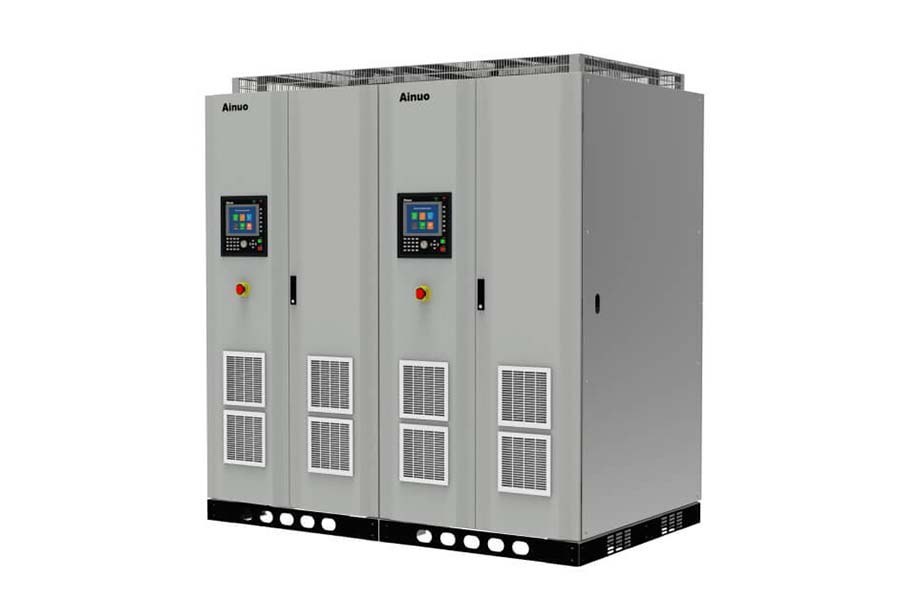
The fundamental difference is that a battery simulator is designed to emulate the electrical behavior of a battery, while a DC power supply is designed to deliver stable, controlled DC power. Both can energize a device under test, but they do not create the same test conditions.
A battery simulator may reproduce state of charge (SoC), state of health (SoH), charging and discharging behavior, transient conditions, and dynamic internal resistance. A power supply instead provides set voltage or current through manual settings or programmable interfaces.
| Test aspect | Battery simulator | DC power supply |
|---|---|---|
| Primary role | Emulates battery electrical behavior | Supplies stable, controllable DC power |
| Battery dynamics | Can represent changing conditions and resistance | Does not replicate complex battery characteristics |
| Fault testing | May support controlled fault scenarios | Provides basic protection rather than intentional fault simulation |
| Typical use | BMS, charger, EV, and battery-dependent device testing | Prototyping, functional testing, and bench-level debugging |
When should you use a battery simulator?
Use a battery simulator when the test must show how a product behaves under realistic or changing battery conditions. This is relevant to BMS development and validation, charger development, EV subsystems, energy storage systems, and battery-powered products.
For example, a test may need to vary SoC, represent internal-resistance changes, apply charge or discharge transitions, or evaluate a response to a fault condition. These requirements go beyond a steady DC output.
- BMS testing: evaluating operation across battery states and selected fault scenarios.
- Charger development: testing charging behavior against varying battery conditions.
- EV and energy storage testing: working with multi-cell battery pack behavior.
- Battery-powered device development: studying a device under changing load or battery-related conditions.
When is a DC power supply the practical choice?
A DC power supply is practical when a circuit or device only needs clean, stable, adjustable power. It is suited to basic electronics laboratories, prototype boards, production functional tests, and bench debugging where battery-specific behavior is not part of the test.
Microcontrollers, sensors, controllers, and early-stage electronic assemblies can often be powered directly from a DC supply. Basic protections such as overvoltage, overcurrent, and thermal shutdown are associated with power supplies, but these protections are not the same as simulating a battery fault.
Why does internal resistance matter in battery testing?
Internal resistance matters because a real battery does not behave like an ideal voltage source. The source material describes internal resistance as changing with SoC, temperature, age, and load, which can affect how a BMS or charger responds.
A battery simulator can be used to emulate this changing resistance as part of a more realistic test. A conventional power supply typically has low internal resistance and is not intended to reproduce those battery-related variations.
Can a battery simulator test faults that a power supply cannot?
A battery simulator can support controlled fault scenarios for safety-related testing, including overvoltage, undervoltage, overcurrent, short circuit, and reverse polarity. These scenarios can help evaluate BMS fault detection and response.
A DC power supply includes its own protective functions, but the source material distinguishes those protections from intentional, controlled fault injection. Therefore, a supply should not be assumed to replace a simulator when fault-state testing is required.
How do multi-cell battery tests differ from using a power supply?
Battery simulators can emulate multi-cell packs with individually programmable cells, according to the source material. This capability is relevant when a test requires cell-level behavior in applications such as EV battery packs, aerospace energy systems, or industrial storage.
Power supplies are generally single-channel DC sources. Multi-channel versions may be available, but the source material does not treat them as a substitute for cell-level battery modeling.
How should you choose between a battery simulator and a power supply?
Choose based on the behavior the device under test needs to experience. If the device only requires stable DC power, a power supply is the simpler fit; if it must react to battery dynamics, changing resistance, charge or discharge states, or controlled faults, select a battery simulator.
- Choose a battery simulator for BMS validation, charger testing, battery-dependent products, multi-cell behavior, or repeatable battery-condition tests.
- Choose a DC power supply for circuit bring-up, prototype power, sensor and controller testing, and general functional work.
Repeatability and automation requirements also influence the decision. The source material associates simulators with software-controlled modeling and repeatable battery-condition testing, whereas power supplies remain appropriate for straightforward DC powering tasks.