The rapid growth of the electronics, electrical panel, automotive, and renewable energy industries has created increasingly stringent requirements for wire processing quality. Even a stripped wire end that is off by a few tenths of a millimeter or a slightly scratched copper conductor can compromise the electrical connection of an entire assembly after installation.
For this reason, many manufacturers have shifted from manual wire stripping to automatic wire stripping machines to achieve better control over both productivity and product quality. Beyond shortening production time, these machines also help reduce hidden operating costs that are often overlooked in daily reports, including defective products, material waste, and the time required to train new operators.
What Is an Automatic Wire Stripping Machine?
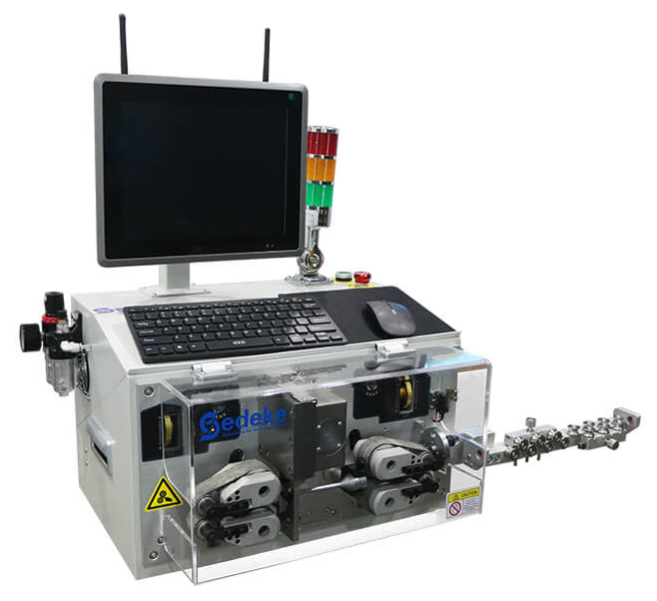
An automatic wire stripping machine is specialized equipment designed to cut and remove the insulation from electrical wires or cables according to preset stripping lengths and cutting depths. Depending on the machine model, it can automatically perform cutting, single-end stripping, double-end stripping, or multi-layer stripping within a single operating cycle. Many modern machines also feature touchscreen interfaces, programmable job memory, and rapid parameter switching for different wire types.
Unlike manual hand tools, automatic wire stripping machines use precision-controlled cutting blades that accurately regulate cutting force. The insulation is removed without damaging the conductor underneath, which is especially important when processing signal wires or small-gauge cables where conductor damage is difficult to detect with the naked eye.
In high-volume manufacturing, consistency is often more valuable than producing only a few acceptable parts. Uniformly processed wire ends allow subsequent crimping, soldering, and assembly operations to proceed more efficiently while minimizing adjustments and rework.
This is why manufacturers of electrical cables, control panels, and electronic equipment are increasingly automating what may appear to be a relatively small but highly critical production process.
7 Benefits That Help Reduce Manufacturing Costs
1. Stable Productivity Throughout Every Shift
An cable cut tripper can process thousands of wire pieces during a single production shift while maintaining consistent speed and accuracy. This consistency is particularly valuable when manufacturers need to fulfill large orders or meet tight delivery schedules, as production no longer depends on operator skill levels or physical endurance.
2. Lower Defect Rates from the Very Beginning
Wire processing is the first step in a sequence of manufacturing operations. A wire stripped too short, too long, or with a damaged conductor may require the entire assembly to be repaired or discarded.
Traditional manual stripping using hand-operated wire strippers often depends heavily on the operator's experience, technique, and physical condition, resulting in inconsistent quality and productivity.
Automatic wire stripping machines eliminate much of this variability by maintaining precise and repeatable processing parameters, significantly reducing scrap rates and minimizing inspection and rework time.
3. Reduce Hidden Costs That Rarely Appear in Financial Reports
When evaluating equipment investments, many companies compare only the purchase price with labor costs.
However, the greatest savings often come from less visible factors, including reduced material waste, fewer replacement production runs due to defective products, less downtime for troubleshooting, and shorter training periods for new employees.
4. Better Protection for Wire Integrity
For signal cables, control wires, and small-gauge conductors, slight scratches on the copper core may go unnoticed immediately after processing.
The consequences often become apparent only after extended service, when oxidation develops or localized overheating occurs at damaged sections.
Automatic wire stripping machines precisely control blade penetration depth, greatly reducing the risk of conductor damage and improving the long-term reliability of the finished product.
5. Faster Changeovers Between Production Orders
Modern manufacturing facilities often process multiple wire specifications within the same production day.
Instead of manually adjusting machine settings each time a product changes, many automatic wire stripping machines allow processing parameters to be stored in memory. Operators simply select the appropriate program and resume production, significantly reducing changeover time.
6. Stronger Foundation for Quality Management
The repeatability of automated processing makes production data much easier to monitor and control.
When cutting length, stripping length, and operating parameters are standardized, quality control teams can quickly identify the root cause of any deviations. Product traceability also becomes much simpler than in production environments that rely heavily on manual operations.
This capability is particularly valuable for export-oriented manufacturers implementing quality management systems such as ISO and IATF.
7. Faster Return on Investment as Production Volume Increases
For companies processing large quantities of wires every day, the payback period for an automatic wire cutting and stripping machine is often shorter than expected.
Savings are generated through a combination of reduced labor requirements, lower defect rates, increased production capacity, and decreased material waste.
The true value of the investment is measured not only by the number of products produced but also by its ability to consistently maintain high-quality output over the long term.
As quality standards and productivity requirements continue to rise, automatic wire stripping machines have evolved from simple production aids into essential components of modern wire processing operations.
Which Businesses Should Invest in an Automatic Wire Stripping Machine?
Wire Insulation Stripper are particularly well suited for companies that regularly process electrical wires or cables as part of their manufacturing operations, including:
Electrical control panel and switchboard manufacturers
Electrical and electronic equipment assembly companies
Automotive and motorcycle wire harness manufacturers
Telecommunications equipment manufacturers
Machinery builders and industrial automation system integrators
Contract wire processing and cable assembly workshops
Even companies with relatively modest production volumes may benefit from investing in an automatic wire stripping machine if they frequently experience shortages of skilled labor or need to maintain consistent product quality across multiple production batches.