What is an industrial liquid flow meter?
A liquid flow meter is a device used to record the amount of liquid passing through a pipeline over a defined period. The information obtained reflects consumption levels, material usage patterns, and changes in the system due to fluctuating operating conditions. This provides operators with a basis for timely adjustments, minimizing prolonged deviations.
Depending on the characteristics of the fluid and the application requirements, flow meters are developed based on various principles such as turbine, electromagnetic, or ultrasonic. Among these, ultrasonic flow meters are increasingly popular due to their ability to monitor flow from outside the pipe, making them suitable for continuously operating systems.
Applications of flow meters in various industries.
In the chemical and petrochemical industries, controlling material flow directly impacts product stability. Flow meters help monitor the amount of liquid entering each stage, observe the mixing process, and control the product flow after processing before storage or distribution.
In the food and beverage industry, this equipment is essential for mixing, filling, and water supply. Maintaining a stable flow rate ensures consistency in the production formula and minimizes material loss during operation.
In water and wastewater treatment systems, flow meters are installed at various locations to monitor the influent water volume, chemical usage, and post-treatment discharge. Knowing these parameters facilitates water resource management and wastewater control. Similarly, in the paper and textile industries, monitoring water and chemical flow ensures stable processes and easier control of product color and quality.
In the pharmaceutical and medical fields, fluid flow needs to be closely monitored to ensure the dispensing process meets requirements. In HVAC and energy systems, flow meters help monitor coolant, chilled water, or heat transfer fluids, allowing for system adjustments to meet actual usage needs.
Benefits of using a liquid flow meter
Regular flow monitoring helps detect abnormal changes early, such as sudden increases or decreases in flow rate or prolonged fluctuations. When these signs are identified promptly, the risk of losses and production disruptions is significantly reduced.
In addition, effective flow management helps businesses be more proactive in their material usage, while also supporting the fulfillment of safety and environmental requirements in industrial production.
EMIN distributes various lines of liquid flow meters.
Currently, EMIN offers a diverse range of liquid flow measurement solutions to meet various industrial needs. Among these, clamp-on ultrasonic flow meters are often chosen when rapid flow monitoring is required without system interruption. These devices are suitable for a wide variety of liquids and are widely used in water treatment, HVAC systems, and continuously operating production lines.
A prime example is the PCE PCE-TDS 200 M, a handheld clamp-on ultrasonic flow meter commonly used to monitor the flow rate of water, oil, and other common liquids in water treatment systems, HVAC, or production lines. Because it measures from the outside of the pipe, it is suitable for locations that are difficult to access or require flexible testing at multiple points.
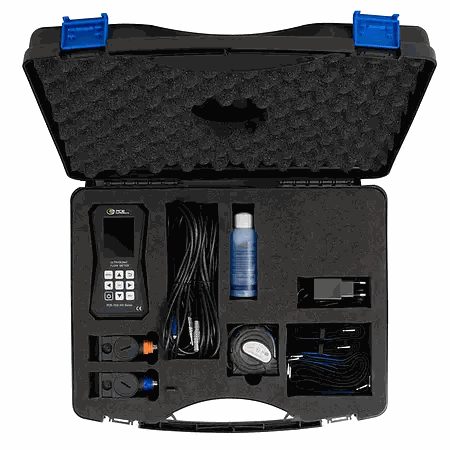
In addition, EMIN also distributes Ultrasonic Flow Meter and mechanical flowmeters for fixed installations on pipelines. These options make it easy for users to find a solution that suits their operating conditions and the specifics of each application.